

MCAT Exam; Everything You Need to Know

Picture this: it's midnight, you're a pre-med junior, and you've just pulled up the AAMC website for the first time. You see four sections, a 7.5-hour test day, and a score range that feels like a foreign language. The MCAT exam sits at the center of your medical school dreams — and right now, it feels impossibly large.
I've been there. As someone who scored 522 on the MCAT and has spent over a decade coaching pre-med students at UCLA and Columbia — guiding hundreds of students into top MD and DO programs — I know exactly what this moment feels like. And I'm here to tell you: with the right roadmap, this exam is absolutely conquerable.
This guide will give you everything you need: a clear breakdown of the MCAT exam's structure, scoring system, prep strategy, study timeline, and the insider coaching insights that only come from 10+ years in the trenches. Whether you're a student charting your first steps or a parent trying to understand what your child is up against, you're in the right place.
What is the MCAT Exam?
The MCAT (Medical College Admission Test) is a standardized, computer-based exam administered by the AAMC (Association of American Medical Colleges). It assesses knowledge in biological sciences, chemistry, psychology, sociology, and critical reasoning. The exam has 4 sections, lasts approximately 7.5 hours, and is scored on a scale of 472–528. Most competitive medical schools expect scores of 511 or higher.
What Is the MCAT Exam? Definition, Purpose & Who Takes It
MCAT stands for Medical College Admission Test. It's a standardized, computer-based exam owned and administered by the AAMC, and it is the primary academic benchmark that medical schools use to evaluate applicants alongside GPA and extracurricular experience.
The MCAT exists for a simple reason: undergraduate GPAs vary wildly across institutions, majors, and grading standards. A 3.9 from one school may not mean the same thing as a 3.9 from another. The MCAT levels the playing field — it's the one metric that every MD and DO applicant faces on identical terms.
In my 10+ years of mentoring pre-med students, I'm asked regularly whether the MCAT is truly necessary. The answer is unambiguous: yes. Not a single top-30 medical school has moved away from requiring it. Test-optional policies are rare, narrow exceptions (often applying to specific dual-degree or pipeline programs) — they are not the norm, and banking on them is a dangerous strategy. The MCAT remains the single most heavily weighted application component after GPA.
If you're wondering how the MCAT fits into the larger picture of medical school applications, we've laid out every step in our How to Get into Medical School Step by Step Guidebook — worth bookmarking now and returning to as you progress.
MCAT Full Form and What It Stands For
MCAT = Medical College Admission Test. The exam is owned and administered by the AAMC (Association of American Medical Colleges), which has overseen medical school admissions testing since 1928. The current format — the one you'll be taking — was substantially redesigned in 2015, adding the Psychological, Social & Biological Foundations of Behavior section and expanding the science content. This matters because students sometimes stumble across older prep materials that no longer reflect the actual exam. Make sure everything you study from is 2015-format or newer. The MCAT is accepted by virtually all MD and DO programs in the United States and Canada.
Who Should Take the MCAT Exam?
The MCAT is for anyone applying to medical school in the US or Canada. That includes:
Traditional pre-med undergraduates — the most common group
Post-baccalaureate students making a career switch into medicine
Students applying to DO (osteopathic) programs — MCAT is equally required
International students applying to US MD programs
Students applying to MD-PhD programs (same MCAT; higher score expectations)
MCAT Exam Format — Sections, Question Types & Total Time
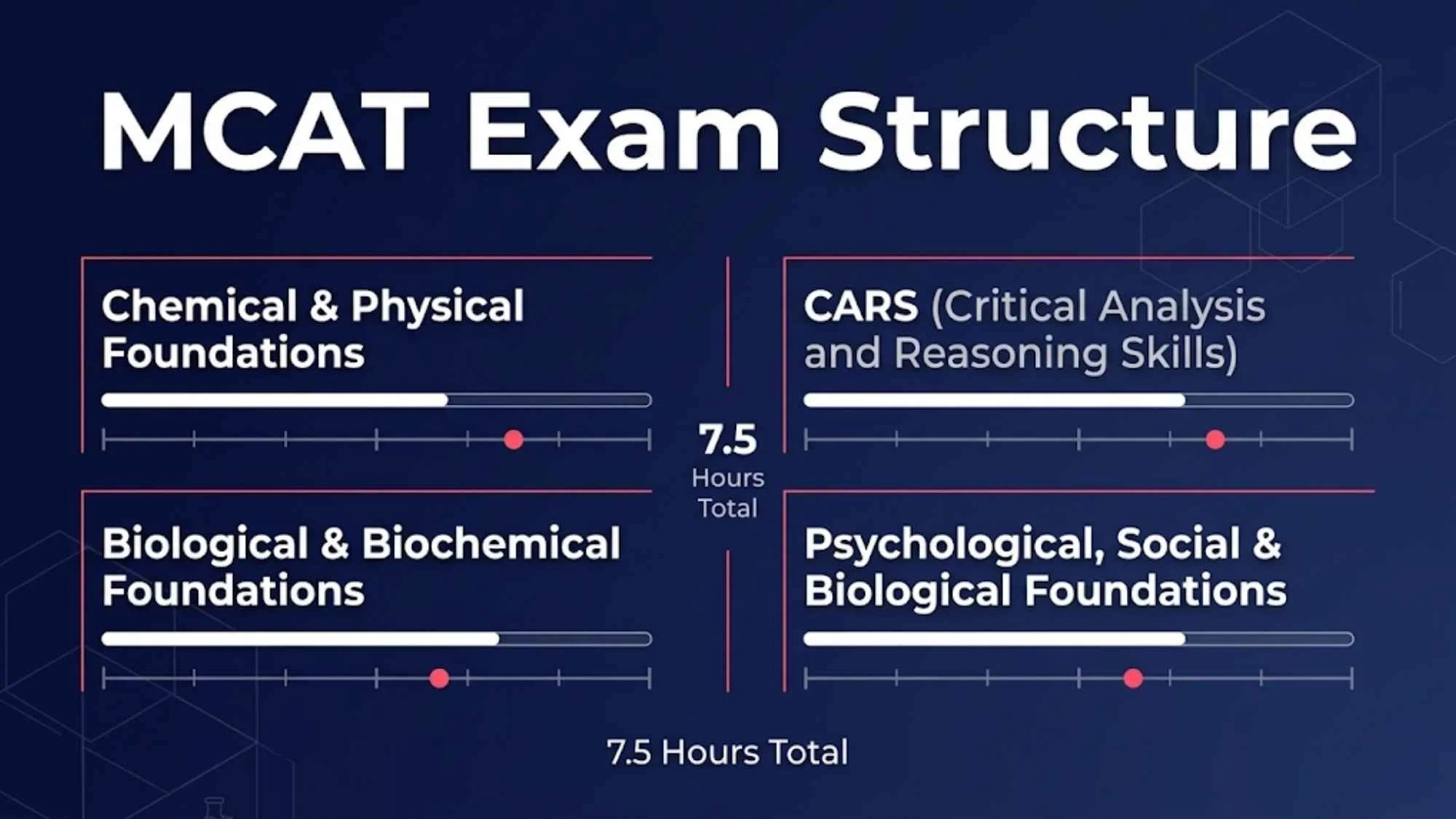
The MCAT has 4 sections, totaling ~6 hours and 15 minutes of actual testing time and approximately 7.5 hours including scheduled breaks. Every question is multiple choice with four answer choices. Most questions are passage-based; a smaller number are discrete (standalone) questions that don't require reading a passage first.
| Section | Full Name | Questions | Time |
|---|---|---|---|
| Section 1 | Chemical & Physical Foundations of Biological Systems | 59 | 95 min |
| Section 2 | Critical Analysis and Reasoning Skills (CARS) | 53 | 90 min |
| Section 3 | Biological & Biochemical Foundations of Living Systems | 59 | 95 min |
| Section 4 | Psychological, Social & Biological Foundations of Behavior | 59 | 95 min |
Optional breaks are built into the schedule between sections. Do not skip them. You may feel like powering through, but your cognitive performance in the back half of the exam depends heavily on how you manage your energy in the first half. Use the breaks.
CARS Section — Why It Deserves Special Attention
The Critical Analysis and Reasoning Skills (CARS) section requires zero science background. Passages come from humanities, social sciences, ethics, and philosophy — and you're evaluated purely on your ability to read critically, identify arguments, draw inferences, and evaluate conclusions. It cannot be improved through content review alone.
The most effective CARS strategy: treat it like a sport. You improve by doing it daily, not by reading a textbook about it. Start reading editorial pieces, long-form journalism, and philosophical essays from day one of your prep — not the week before your exam. Programs like MD-PhD pipelines weight CARS heavily, and it's one area where early, consistent practice produces disproportionate gains.
For structured guidance on CARS strategy, the AAMC's official CARS resources are the gold standard — use them alongside daily reading practice.
Psych/Soc Section — The Most Underestimated Section
Section 4 — Psychological, Social & Biological Foundations of Behavior — covers psychology, sociology, and the biological underpinnings of behavior. This section tests specific theories and theorists (Freud, Piaget, Erikson, Vygotsky, Bandura, and many more), and memorization of those frameworks is required.
Every year, without exception, students leave 5–8 points on the table by treating Psych/Soc as a "bonus" section. It isn't. Flashcard-based studying for Psych/Soc terminology and theory is the fastest route to score improvement — and it's the section where diligent prep pays off faster than anywhere else.
MCAT Scoring — How Is the MCAT Scored?
Each of the four sections is scored on a scale of 118–132. Your total MCAT score is the sum of all four section scores, ranging from 472–528. The midpoint — 500 — represents the 50th percentile of all test-takers.
| Score | Percentile | Competitiveness Tier |
|---|---|---|
| 472–499 | Below 50th | Below average — retake recommended |
| 500–504 | 50th–63rd | Average — borderline for many MD programs |
| 505–509 | 64th–76th | Competitive for some MD & strong DO programs |
| 510–514 | 77th–87th | Competitive for most MD programs |
| 515–517 | 88th–93rd | Competitive for top 25 MD programs |
| 518–521 | 94th–98th | Competitive for top 10 MD programs |
| 522–528 | 99th+ | Elite — top medical schools nationwide |
Scores are reported approximately 30–35 days after your test date. They are valid for 3 years, which matters if you're planning a gap year between undergrad and application. Importantly, the AAMC allows students to void their score on test day before seeing results — this option is worth considering only if test day goes catastrophically wrong, not as a precaution. Use it sparingly.
MCAT Score Percentiles — What Do They Mean?
A percentile tells you how your score compares to all other test-takers over a rolling 3-year cohort. A 510 doesn't mean you answered 510 questions correctly — it's a scaled score that places you at roughly the 80th percentile. The AAMC recalculates percentile rankings annually, so a 510 today may represent a slightly different percentile next year.
The most important benchmarking tool you have is the MSAR (Medical School Admissions Requirements) database. Look up your target schools' median MCAT scores there — that specific number matters far more than any generic benchmark.
How Many Times Can You Take the MCAT?
The AAMC permits: 3 attempts per testing year, 4 attempts within a 2-year period, and 7 lifetime attempts. Most medical schools see all of your scores — policies on score averaging vs. highest score vary by program. Retaking is common and not penalized, provided improvement is demonstrated. At HYE Tutors, we've coached many students through a successful second attempt. A 5–7 point improvement on a retake is viewed very favorably by admissions committees.
MCAT Exam Dates, Registration & Test Centers
The MCAT is offered approximately 25–30 times per year, running from January through September. Registration opens roughly 6 months before each test date through the AAMC's official registration portal.
Popular test dates — especially May through July — fill up 2–3 months in advance. Register the moment dates open. Treat it like buying concert tickets for a sold-out show, because functionally, that's what it is. One of the most avoidable disasters I've seen: a student who completed 12 full-length practice exams and was genuinely ready — only to find no available test date within their application window because they waited too long.
Key registration logistics:
Testing centers: Prometric testing centers across the US and internationally
Accommodations: AAMC offers extended time and other testing accommodations — apply separately and early, as the review process takes time
Application calendar context: AMCAS (the American Medical College Application Service) opens June 1 each year — plan your MCAT date backward from this deadline
Unsure how to plan your MCAT timeline around your application cycle? Book a free strategy session with an HYE Tutors MCAT advisor — we'll map out your entire pre-med roadmap.
MCAT Syllabus — What Subjects Does the MCAT Cover?
The AAMC publishes a detailed content outline — download the free AAMC Official Content Specifications as a foundational reference. Here's what each section tests:
Section 1 — Chemical & Physical Foundations of Biological Systems
General chemistry: thermodynamics, acid-base chemistry, electrochemistry
Organic chemistry: functional groups, stereochemistry, reaction mechanisms
Physics: mechanics, fluids, optics, electricity
Biochemistry: enzyme kinetics, metabolism basics
Math note: basic algebra and arithmetic only — no calculus required
Section 2 — Critical Analysis and Reasoning Skills (CARS)
No specific content to memorize — purely skill-based
Tests inference, argument analysis, author's purpose, strengthening/weakening conclusions
Reading materials: humanities, ethics, arts, social science passages
Improvement strategy: daily reading practice, not content review
Section 3 — Biological & Biochemical Foundations of Living Systems
Molecular biology: DNA replication, transcription, translation
Genetics: Mendelian and molecular genetics
Biochemistry: metabolic pathways, enzyme regulation
Physiology: all major organ systems — cardiovascular, renal, respiratory, nervous, endocrine
This is the most content-heavy section — plan more study hours here than anywhere else
Section 4 — Psychological, Social & Biological Foundations of Behavior
Psychology theories and social determinants of health
Key theorists: Piaget, Freud, Erikson, Vygotsky, Bandura — memorization required
Sociology: stratification, discrimination, health disparities, social institutions
Biology of behavior: neuroscience, stress response, sensation and perception
How to Prepare for the MCAT — Study Plan & Strategy
This is where I'll stop speaking generally and give you the same framework I use on day one with every new student. There's no one-size-fits-all approach — but there is a clear structure that works.
How Long Should You Study for the MCAT?
The honest answer: it depends on where you're starting. This is why I tell every student the same thing before they ever register for a test date:
Most students: 3–6 months of dedicated study, 15–20 hours per week minimum
Strong science background: 3–4 months may be sufficient
Career-changers or science content gaps: 6–9 months recommended
Full-time vs. part-time prep: adjust timeline and daily hour commitment accordingly
Best MCAT Prep Resources and Books
AAMC Official Materials (Section Bank, Question Packs, Full-Length Practice Exams) — non-negotiable
Kaplan MCAT Complete 7-Book Set — comprehensive content review, good for first-pass
Princeton Review MCAT — strong on strategy tips alongside content
Blueprint MCAT — excellent digital platform with adaptive learning features
Anki flashcards for Psych/Soc and Biochemistry terminology — highly recommended
Khan Academy MCAT — free, AAMC-partnered content; ideal for supplemental video review
MCAT Study Schedule — Week-by-Week Framework
Phase 1 (Months 1–2): Content review — work through each section systematically, prioritize Bio/Biochem
Phase 2 (Months 2–4): Passage-based practice — apply content to exam-style questions daily; begin CARS reading practice
Phase 3 (Final 4–6 weeks): Full-length practice exams every weekend + deep review of every wrong answer
Final week: Light review only. No new material. Prioritize sleep, nutrition, and mental reset
One non-negotiable I enforced on myself: I did a full-length practice exam every single weekend for the final six weeks. Not because I loved waking up at 7am on Saturday — but because test day is 7.5 hours long, and your brain needs to be trained for that endurance. Track every weak area in a dedicated error log spreadsheet.
MCAT Prep Tips From an Experienced Tutor
Take your diagnostic exam before registering for a test date — always
Start CARS reading practice immediately — do not wait
Review every wrong answer's full explanation, not just the correct answer
Build your high-yield topic list from your own weak areas, not someone else's
Sleep is a study tool — protect it during final prep weeks
Simulate test day conditions at least 3 times: same start time, same break schedule, same snacks — your brain performs better in a familiar environment
MCAT Score Requirements for Medical School — What Score Do You Need?
Here are the real numbers, organized by school tier. Use these as targets, not ceilings.
Harvard, Johns Hopkins, Stanford, UCSF: average accepted MCAT ~519–522
Top 25 MD programs: typically expect 515+
Mid-tier MD programs: average accepted MCAT ~510–515
DO programs: average accepted MCAT ~504–508
Important context: the MCAT score gets you through an initial filter — but medical school admissions is holistic. GPA, research experience, clinical hours, letters of recommendation, and your personal statement all carry weight. Your MCAT score gets you to the table; everything else determines whether you get a seat.
Your MCAT score gets you noticed — your personal statement makes you memorable. We've written a complete guide on How to Write a Personal Statement for Medical School if you want to get ahead on that piece now.
Interestingly, your undergraduate major has less impact on MCAT performance than most students assume. We explored this in depth in our piece on What is the Best Pre-Med Major? — worth reading if you're early in your pre-med planning.
Not sure if your current practice scores are competitive for your target schools? Book a free MCAT strategy session with HYE Tutors — we'll review your score report and help you build a school list that fits your profile.
MCAT vs. Other Graduate Entrance Exams
If you've been researching professional school options, you've probably seen these exams come up. Here's how they compare:
| Exam | For | Score Range | Duration |
|---|---|---|---|
| MCAT | Medical school (MD/DO) | 472–528 | ~7.5 hours |
| LSAT | Law school | 120–180 | ~3.5 hours |
| GRE | Graduate school (most fields) | 260–340 | ~3.75 hours |
| DAT | Dental school | 1–30 | ~5 hours |
| GMAT | Business school (MBA) | 205–805 | ~3.5 hours |
The MCAT is widely considered the most content-heavy of all graduate entrance exams. It's unique in that it demands both deep scientific knowledge and sophisticated reasoning ability — simultaneously, sustained over 7.5 hours. A student preparing for the LSAT is developing pure reasoning skills. A student preparing for the MCAT is doing that and memorizing biochemistry pathways, anatomy, psychology theory, and physics principles.
Some MD-PhD applicants are also required to submit GRE scores — this is program-specific, so check each program's requirements individually.
Common MCAT Exam Mistakes — And How to Avoid Them
In 10+ years of MCAT coaching, the same patterns appear. Here are the mistakes that cost students the most points — and how to sidestep them.
Registering before taking a diagnostic. The most expensive mistake. Your baseline score tells you how much time you need; don't pick a date on hope.
Over-relying on third-party materials. Supplemental resources have value — but AAMC official content must anchor your prep. No third-party exam replicates the real thing.
Studying content for CARS. CARS cannot be crammed. Vocabulary lists and textbooks will not improve your CARS score. Daily reading practice will.
Skipping or rushing full-length practice exams. Your content knowledge means nothing if you can't deploy it under exam conditions after 4 consecutive hours of testing. Practice exams are not optional.
Treating Psych/Soc as a soft section. It isn't. Neglecting it consistently costs students 5–8 points.
Cramming in the final week. The last week is for consolidation and sleep, not new content. Students who ignore this almost universally underperform relative to their practice scores.
Ignoring pacing. Many students run out of time in Bio/Biochem and CARS. Timed passage practice starting in Phase 2 is the fix.
FAQs
What does MCAT stand for?
MCAT stands for Medical College Admission Test. It is owned and administered by the AAMC (Association of American Medical Colleges) and is required for admission to virtually all MD and DO programs in the United States and Canada.
How hard is the MCAT exam?
The MCAT is genuinely difficult — it is widely considered the most content-intensive graduate entrance exam. It tests both scientific knowledge across four disciplines and high-level reasoning, sustained over 7.5 hours. That said, structured preparation over 3–6 months consistently produces competitive scores. Difficulty is real; it is not insurmountable.
How many times can you take the MCAT?
The AAMC permits 3 attempts per testing year, 4 attempts in any 2-year period, and 7 lifetime attempts. Most medical schools see all scores, though policies on score averaging vs. highest score vary by institution. Retaking with demonstrated improvement is viewed favorably.
What is a good MCAT score?
Context matters: 500 = 50th percentile (average), 510+ = competitive for most MD programs (~80th percentile), 515+ = competitive for top 25 programs, 518+ = competitive for top 10 programs. Always compare your score to the median MCAT of accepted students at your specific target schools, available via the MSAR database.
When should I take the MCAT?
Most students take the MCAT in the spring of their junior year or during a gap year before submitting applications. The key rule: your score must still be valid (within 3 years) when you apply. Take it when you have completed all relevant prerequisite science coursework — not before.
How long is the MCAT exam?
Approximately 7.5 hours total, including breaks. Actual testing time is roughly 6 hours and 15 minutes across 4 sections. Plan for a full day — do not schedule commitments immediately after.
Can I take the MCAT without a pre-med major?
Yes. The MCAT tests specific content knowledge, not any particular undergraduate major. Any student who completes the prerequisite science coursework — biology, general chemistry, organic chemistry, biochemistry, physics, psychology, and sociology — can sit the exam. Read our What is the Best Pre-Med Major? article for more on how major choice affects your medical school application broadly.
Is the MCAT required for DO schools?
Yes. DO (osteopathic) programs require the MCAT. Score expectations are typically slightly lower than those of top MD programs, but strong scores remain essential. The MCAT is the MCAT — there is no separate osteopathic exam.
Should You Work with an MCAT Tutor?
HYE Tutors works with pre-med students one-on-one, tailoring every MCAT plan to the individual student's score report, timeline, and target schools. Book a free consultation today — no commitment required.
Conclusion
The MCAT exam is the most consequential academic test on your path to medical school — a 4-section, 7.5-hour evaluation of your scientific knowledge, reasoning ability, and endurance. Understanding its structure, scoring system, and preparation requirements is the first step toward approaching it strategically, not fearfully.
The students who perform best on the MCAT aren't always the ones with the highest GPAs or the most natural aptitude for standardized tests. They're the ones who started early, practiced consistently, reviewed their mistakes relentlessly, and treated the exam as the trainable skill it is.
For parents reading this: if your child is in the early stages of a pre-med path, the best investment you can make right now is helping them understand the MCAT early — not in a panic the semester before applications. Early clarity creates better outcomes.
Explore more on hyetutors.com, including our guides on medical school applications, personal statement writing, and pre-med major selection. Whether you're just starting your pre-med journey or preparing for a retake, HYE Tutors' MCAT specialists are here to help you build a plan that fits your timeline and your goals. Schedule your free session today →