

What Is Euler’s Number (e) in Math? Why It Matters for Growth, Calculus & Exams
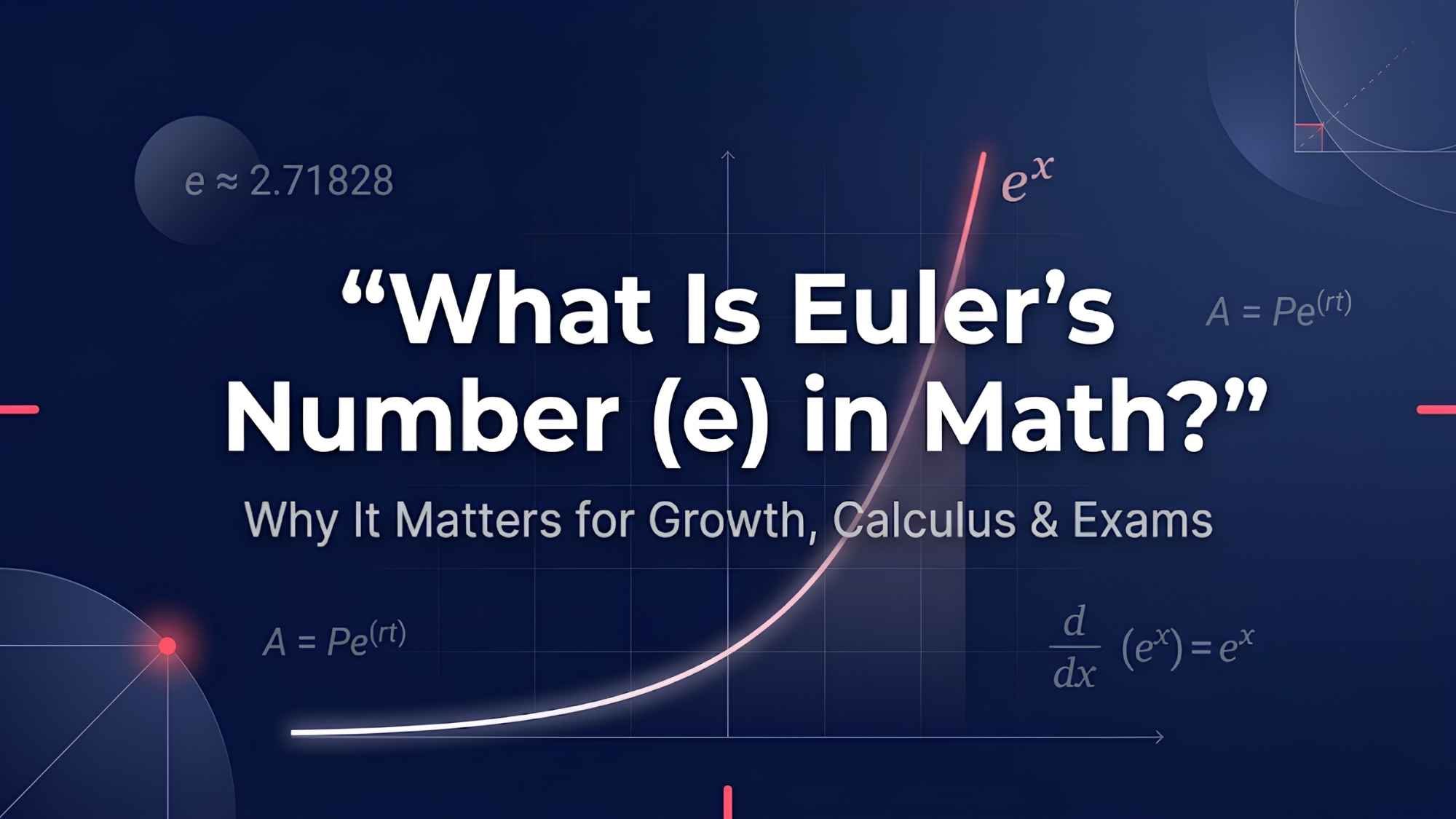
Picture this: you're sitting at your desk staring at your graphing calculator before a big AP Calculus exam, and right there on the keypad is the letter e. Not x. Not y. The letter e. And unlike every other letter in math class, this one isn't a variable you solve for — it's something else entirely. Something specific. Something that has puzzled students for generations, even as it quietly powers some of the most elegant mathematics in existence.
So, what is Euler's number? It's a question we field constantly at HYE Tutors, and for good reason. Euler's number e appears across calculus, compound interest, population growth, radioactive decay, and even the equations behind the COVID-19 spread models you might have seen in the news. In other words: it's everywhere.
As a team of tutors with affiliations at Columbia, UC Berkeley, and UCLA — with over five years of one-on-one experience guiding students through AP Calculus, SAT prep, and college-level math — we've walked hundreds of students through this very moment of confusion. The good news? Once e clicks, it really clicks. And by the end of this guide, you'll understand what e is, where it comes from, why it matters for your exams, and how to use it confidently.
“Euler’s number, written as e, is an irrational mathematical constant approximately equal to 2.71828. It is the base of the natural logarithm and arises naturally when calculating continuous growth or decay. Like π (pi), e never ends and never repeats. Named after Swiss mathematician Leonhard Euler, it is one of the most important numbers in mathematics — appearing in calculus, finance, biology, and physics.”
What Is Euler's Number (e) in Math?
In our five years of tutoring, Euler's number has appeared on AP Calculus AB exams, AP Calculus BC free-response sections, ACT Math, and even in high school biology labs. We've worked with students who glossed over e for an entire semester — treating it vaguely as "some number" — and then watched them struggle on problems that should have been straightforward. We've also worked with students who took the time to genuinely understand e, and those students almost always perform better across the board. So let's build that understanding from the ground up.
Euler's Number Definition — What Does e Mean in Math?

Let's start simple. Euler's number, written as e, is a mathematical constant — a fixed, specific value that never changes, just like π (pi). It is not a variable. You cannot solve for it. It simply is, and its approximate value is:
e ≈ 2.71828182845…
The decimal goes on forever without repeating — which is what makes e an irrational number. It is also transcendental, meaning it is not the root of any polynomial with rational coefficients (a detail mostly relevant at the college level, so don't worry too much about that for now).
Euler's number is the base of the natural logarithm, written as ln. Just as π describes the geometry of circles, e describes the mathematics of continuous growth and change. And one quick pronunciation note before we go further: it's named after Leonhard Euler, whose name is pronounced "Oiler" — not "Yooler." We've made this correction in tutoring sessions more times than we can count, so consider yourself ahead of the curve.
The practical takeaway for most students: you don't need to memorize all the decimals. For AP Calculus and ACT Math, knowing that e ≈ 2.718 and being able to use the eˣ key on your calculator will take you very far.
Where Does Euler's Number Come From? (The Origin of e)
This is our favorite part to teach, because the origin of e isn't some abstract mathematical accident — it comes from a beautifully concrete question about money.
Imagine you deposit $1 in a bank account that pays 100% annual interest. Simple enough. If the bank compounds interest once per year, you end the year with $2.00. Not bad. But what if the bank compounds more frequently?
Compound once (annually): $2.00
Compound twice (every 6 months): $2.25
Compound monthly (12 times): ≈ $2.613
Compound daily (365 times): ≈ $2.7145
Compound continuously (infinite times): ≈ $2.71828… → this is e
As the compounding becomes more and more frequent — approaching infinity — the result converges on a single, specific number. That number is e. Mathematically, this is expressed as:
e = lim(n→∞) (1 + 1/n)ⁿ
The key insight: e is the mathematical result of infinite compounding growth. It's not arbitrary — it's the number that nature itself keeps arriving at when growth happens continuously. That's why mathematicians call it nature's growth constant.
We always use the bank account story in our first session on e. Without fail, every student gets it immediately — and once you understand the origin of e, the formula stops feeling like something to memorize and starts feeling inevitable.
What Is the Value of Euler's Number?
The value of e is approximately 2.71828 — that's the figure you'll see on most exams and in most textbooks. Here's what students need to know practically:
For AP Calculus and ACT Math, knowing e ≈ 2.718 is almost always sufficient
On your graphing calculator (TI-84), press 2nd then LN to access the eˣ function
e is irrational: its decimal expansion is infinite and non-repeating
e is transcendental: it cannot be expressed as the root of any rational polynomial (college-level detail)
Euler's Number vs. Euler's Formula — Are They Different?
Yes, and this distinction trips up a lot of curious students. Euler's number is the constant e ≈ 2.71828, which is what this entire article is about. Euler's formula is a separate (though related) equation from complex analysis:
e^(iπ) + 1 = 0
This equation — often called Euler's identity — is frequently described as "the most beautiful equation in mathematics" because it connects five of the most fundamental constants: e, π, i (the imaginary unit), 1, and 0. It's genuinely stunning.
But here's the practical note: Euler's identity is a college-level or advanced pre-calculus topic. You won't need it for AP Calculus AB, SAT, or ACT. We mention it because at least one student per semester asks us about the "beautiful equation" they saw online — now you have context without the confusion.
Properties of Euler's Number — What Makes e Special?
So why do mathematicians and scientists keep choosing e over other numbers? Because e has a property that is genuinely unique in all of mathematics:
The derivative of eˣ is eˣ itself.
In plain English: if you measure the rate of change of the function eˣ at any point, you get eˣ again. The function is its own derivative. No other base has this property — and it's not a coincidence. It's the reason calculus textbooks reach for eˣ constantly. A few other notable properties:
The natural logarithm (ln) uses e as its base: ln(e) = 1
e appears inside the normal distribution (bell curve) formula used across statistics and science
It appears in Euler's identity, complex analysis, and differential equations at the college level
Students going on to study physics, engineering, biology, economics, or psychology will encounter e in virtually every quantitative course
The derivative property alone is why calculus textbooks love eˣ. It behaves in a way no other base does — and understanding that is a genuine intellectual advantage for students.
The Natural Exponential Function — What Is eˣ?
When you see eˣ in a math problem, that notation means "e raised to the power of x." It is a function — not just a single number — and it's the most commonly used exponential function in calculus and science.
Here's how it behaves:
eˣ is always positive, no matter what value x takes
It is always increasing — it never levels off or turns downward
Its slope at any point equals its value at that point (the derivative property in action)
Graphically, it starts near zero for large negative x values and grows rapidly as x increases
Compare this to other exponential functions like 2ˣ or 10ˣ: they grow similarly, but when you try to differentiate them, you get extra awkward factors (like ln(2) or ln(10)) attached to the result. With eˣ, the derivative is clean, elegant, and — crucially — identical to the original function. That's why calculus prefers e above all other bases.
If you're interested in other famous mathematical constants and the surprising places they appear, our guide on the Golden Ratio in Math explores another remarkable number with deep roots in nature and geometry.
Euler's Number in Real Life — Where Does e Actually Appear?
ne of our favorite moments as tutors is watching students realize that e isn't just a symbol in a textbook — it's behind phenomena they encounter every day. Here's a quick tour:
Compound Interest & Continuous Growth.
We've already seen this one: the continuous compound interest formula A = Pe^(rt) is used in banking and investment. Every time an account compounds "continuously," e is at work in the background. (We'll cover this formula in detail in the exam section below.)
Population Growth & Radioactive Decay.
Whether biologists are modeling bacterial growth in a petri dish or nuclear engineers are tracking radioactive material, the formula A = A₀e^(kt) governs how quantities grow or shrink exponentially over time.
Newton's Law of Cooling.
Ever wonder how quickly your coffee cools down? The rate of temperature change in a cooling object follows an equation built around e. The hotter something is relative to its environment, the faster it cools — and e captures that relationship precisely.
Medicine & Pharmacology.
When you take a medication, your body metabolizes and eliminates it over time. The rate at which drug concentration decreases in your bloodstream? Modeled with e. This is directly relevant to dosing schedules and safe drug design.
Statistics & the Bell Curve.
The normal distribution — that famous bell-shaped curve that describes everything from test scores to heights — contains e inside its formula. Every time a teacher says scores are "normally distributed," e is embedded in the mathematics behind that statement.
Epidemiology & Virus Spread.
The early exponential spread of infectious diseases, including models used during the COVID-19 pandemic, are governed by equations involving e. Understanding e means understanding how and why pandemics grow so rapidly in their early stages.
We always tell our students: if you ever study biology, economics, engineering, or even psychology at the college level — you will see e again. The time you invest understanding it now pays dividends across your entire academic career. Just as we use formulas with squares and exponents to measure physical space, we use e to model change over time — and few mathematical tools are more universally applicable.
Euler's Number in Calculus — Why e Is the Star of Differentiation & Integration
In five years of AP Calculus tutoring, we have seen eˣ appear on every single practice exam we've ever assigned. That is not an exaggeration. For students studying calculus, understanding e isn't optional — it's foundational.
Here's why calculus loves e above all other bases:
The defining calculus fact: d/dx(eˣ) = eˣ
The function eˣ is its own derivative. This is remarkable — no other base has this property. If you differentiate 2ˣ, you get 2ˣ · ln(2). If you differentiate 10ˣ, you get 10ˣ · ln(10). But differentiate eˣ, and you get eˣ, perfectly clean.
The same elegance applies to integration: ∫eˣ dx = eˣ + C. The function is its own integral as well. This is why e is called the "natural" base — it simplifies calculus in ways that no other number can.
For students working with the chain rule, things stay clean but add one step. The derivative of e^(f(x)) is f'(x) · e^(f(x)). A quick example:
Derivative of e^(3x): apply chain rule → 3e^(3x)
Derivative of e^(x²): apply chain rule → 2x · e^(x²)
Derivative of e^(3x+1): apply chain rule → 3e^(3x+1)
These patterns appear on AP Calculus AB and BC exams constantly. We recommend practicing them until they feel automatic — the kind of automatic where your pencil moves before your brain fully processes the problem.
For a deep and free introduction to these derivative rules, Khan Academy's section on the natural logarithm and e is one of the clearest resources we've found online.
Struggling with derivatives involving e? Our tutors at HYE Tutors specialize in exactly this. Book a free session today and we'll work through it together.
Euler's Number and Logarithms — Understanding ln (Natural Log)
Euler's number and the natural logarithm are inseparable — you really can't understand one fully without the other. We spend at least one full tutoring session on this connection with every calculus student we work with, because the confusion between log and ln costs students marks they could easily avoid.
Here's the core relationship: ln (natural logarithm) is simply the logarithm with base e. The two functions — eˣ and ln(x) — are inverse functions. That means they undo each other:
If eˣ = y, then ln(y) = x
ln(1) = 0 (because e⁰ = 1)
ln(e) = 1 (because e¹ = e)
ln(e²) = 2 (because e² = e²)
On a calculator, the "ln" button gives you log base e — this is different from the "log" button, which gives you log base 10. Mixing them up on an exam can unravel an entire multi-step problem, and we've seen it happen more times than we'd like to admit.
For more on the connection between exponents and logarithms — including how these rules work in practice — Math is Fun's guide on logarithms is a reliable and approachable reference. And if you want to brush up on mathematical notation more broadly, our guide on What Is Mean in Math? covers the vocabulary and symbols that appear throughout high school and college math.
How to Use Euler's Number on a Calculator
This is one of the most practical skills for exam day — and one that students often overlook until it's too late. Here's exactly how to access e on the most common devices:
TI-84 Graphing Calculator: Press 2nd, then LN. This opens the eˣ function. Enter your exponent and close the parenthesis.
Scientific Calculators (most models): Look for a key labeled eˣ or exp. Some require pressing 2nd or Shift first.
Google / Phone Calculator: Type "e^2" directly into the Google search bar or switch your phone calculator to scientific mode.
Quick reference values to know:
e⁰ = 1 (any number to the power of zero equals 1)
e¹ ≈ 2.718
e² ≈ 7.389
e³ ≈ 20.09
Common Mistakes Students Make with Euler's Number
Over years of tutoring, we've catalogued the mistakes students make most often with e. Here they are — with the fixes:
❌ Treating e as a variable. The most common mistake, especially in Algebra II. A student will see e in an equation and write "e = 5" in their solution. e is a constant. It doesn't change. It doesn't get solved for. We once worked with an AP Calculus student who had been making this error for an entire semester before we caught it on the first day of our sessions together — it's more common than you'd think.
❌ Confusing ln and log. log (base 10) and ln (base e) are not the same. Mixing them up ruins entire problems. Always check which one the problem is asking for.
❌ Mispronouncing Euler. It's "Oiler," not "Yooler." This won't cost you points on an exam, but it's the kind of detail that signals real familiarity with the material.
❌ Thinking eˣ can be zero or negative. The function eˣ is always positive for any real value of x — including large negative values. It approaches zero but never reaches it.
❌ Misapplying the chain rule. The derivative of e^(3x) is 3e^(3x), not simply e^(3x). The chain rule requires you to multiply by the derivative of the exponent. This error appears on AP Calculus exams regularly.
❌ Rounding e too aggressively. Using 2.7 instead of 2.718 causes compounding errors in multi-step problems. Use your calculator's built-in eˣ function whenever possible.
Just as the Pythagorean theorem is non-negotiable for geometry, understanding e is non-negotiable for calculus. Both are the kind of foundational knowledge that unlocks whole categories of exam questions — and both reward students who actually understand why they work, not just what they say.
Want personalized help preparing for AP Calculus or ACT Math? Book a free session with HYE Tutors — our team has helped hundreds of students master exactly this material.
FAQs
What is Euler's number in simple terms?
Euler's number (e ≈ 2.71828) is the number you get when growth compounds continuously and infinitely. Think of it like a bank account that adds interest not once a year or once a day, but every single instant — the final amount approaches e. It's nature's built-in growth constant.
Why is Euler's number important?
Euler's number is essential in calculus because eˣ is its own derivative — a property unique to this base that simplifies differentiation and integration enormously. It also appears in compound interest, population modeling, physics, and statistics. Across science and engineering, e is as foundational as π.
Is Euler's number the same as pi?
No. Both e and π are irrational mathematical constants, but they represent entirely different things. e ≈ 2.71828 describes continuous growth and is the base of the natural logarithm. π ≈ 3.14159 describes the ratio of a circle's circumference to its diameter. They're related in Euler's identity (e^(iπ) + 1 = 0), but they are distinct constants.
What is e used for in real life?
Euler's number appears in continuous compound interest calculations, population growth and radioactive decay models, drug absorption in pharmacology, the normal distribution curve in statistics, and equations governing how viruses spread. If a quantity grows or decays continuously, e is almost certainly in the math behind it.
How do you calculate Euler's number?
Mathematically, e is defined as the limit: e = lim(n→∞)(1 + 1/n)ⁿ. For practical purposes, use the eˣ button on your calculator (on a TI-84: press 2nd, then LN). You'll rarely need to calculate e from scratch — just know it's approximately 2.71828 and use the calculator function confidently.
What is e to the power of 0?
e⁰ = 1. This follows the universal rule that any non-zero number raised to the power of zero equals 1. It's a foundational fact worth knowing: no matter what base you use — 2, 10, or e — raising it to the zero power always gives you 1.
Is Euler's number rational or irrational?
Euler's number is irrational and transcendental. Irrational means its decimal expansion goes on forever without repeating — you cannot write e as a simple fraction. Transcendental (a stronger condition) means it is not the solution to any polynomial equation with rational number coefficients. It simply cannot be "pinned down" algebraically.
Conclusion
Let's bring it home. Euler's number e is approximately 2.71828, it arises from the mathematics of continuous compounding, and it matters because it is the backbone of calculus, growth modeling, and exam mathematics at every level from pre-calculus to graduate study.
More importantly, e is not intimidating once you understand where it comes from. It's the number that nature keeps arriving at when growth never stops — and once that clicks, everything else (the derivative property, the natural log, the compound interest formula) follows naturally from that single insight.
In our years of tutoring, the students who invest time genuinely understanding e — not just memorizing it — consistently perform better across calculus, pre-calc, and standardized exams. They recognize it in unfamiliar problems. They're not thrown off when it appears in biology or economics. They've built a foundation, not just a flashcard.
Understanding what Euler's number is gives you an edge in math that will last well beyond your next exam. You now have that foundation.
If you'd like to go deeper — with personalized practice problems, exam prep, or one-on-one calculus support — our team at HYE Tutors is here. We've guided students from confusion to confidence with e more times than we can count. We'd love to do the same for yo.